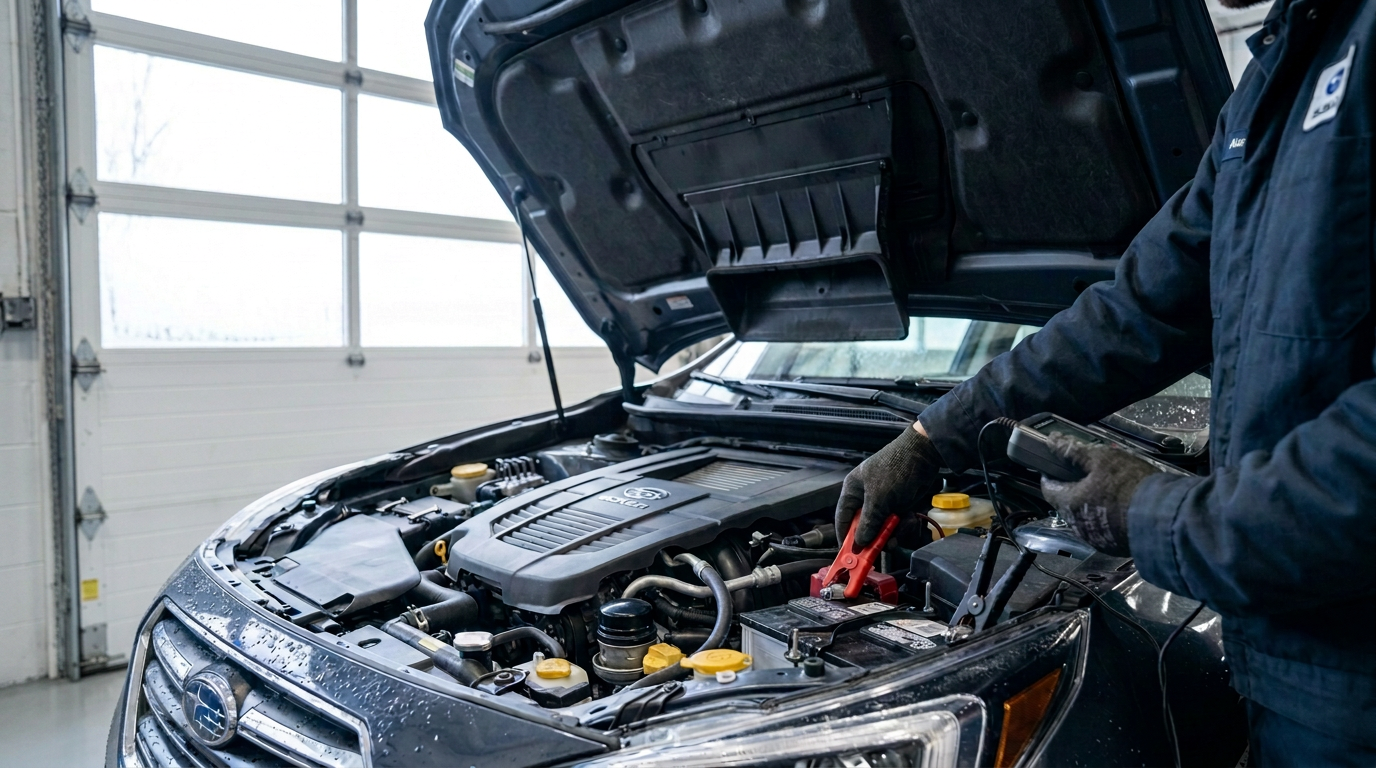
Preparing a Subaru for winter driving requires testing the 12-volt battery and charging system, verifying engine coolant freeze protection, inspecting brake components, checking tire tread depth and cold inflation pressures, and installing winter-grade wiper blades with freeze-resistant washer fluid. Completing these foundational service steps ensures proper mechanical performance and visibility during cold weather and slippery road conditions.
Cold weather places increased physical demands on every mechanical system in your vehicle. Low ambient temperatures reduce battery output while simultaneously increasing engine cranking resistance due to thickened engine oil. At the same time, road surfaces in central Delaware experience sudden shifts from wet rain to icy slush, making traction management and braking response critical for daily driving.
A comprehensive winter preparation routine begins with a complete battery load test. Testing measures cold cranking amps alongside voltage to ensure the battery can start the engine reliably on freezing mornings. Technicians also inspect the alternator output, engine drive belts, and terminal connections for corrosion that could restrict electrical flow.
Next, the cooling system requires verification to ensure the antifreeze mixture ratio provides adequate protection against internal freezing. A proper 50/50 water-and-coolant mix prevents fluid expansion inside the engine block and radiator core during sub-freezing temperatures.
Slippery winter roads demand precise vehicle control and clear vision through the windshield. In flat central Delaware areas like Dover near the St. Jones River, winter dampness and freezing mist rapidly coat windshields with road spray and grime. Replacing worn wiper blades with winter-grade units and filling the reservoir with de-icing washer fluid prevents streaking and ice buildup on the glass. To schedule a winter inspection, visit our Dover service center on 1387 N Dupont Hwy or give our service department a quick call at (302) 550-2876.
Table of Contents
- What Essential Winter Maintenance Services Does Your Subaru Need?
- How Does Subaru Symmetrical AWD Perform in Snow and Ice?
- Does Subaru Symmetrical AWD Replace the Need for Winter or All-Weather Tires?
- How Should You Manage Tire Pressure and Tread Depth in Cold Weather?
- Common Questions About Subaru Winter Service and Maintenance
- Schedule Your Winter Maintenance Service
What Essential Winter Maintenance Services Does Your Subaru Need?
A thorough multi-point inspection is critical before winter, checking battery health, oil viscosity, cooling system mix, brake condition, and wiper effectiveness to keep your Subaru ready for cold weather. Completing these checks prior to freezing weather prevents cold-start issues, maintains stopping ability on slick pavement, and protects engine components from thermal stress.
A full winter service visit addresses several specific mechanical areas:
- Battery and Charging System: Electrical output drops as temperatures decline. Technicians perform a digital conductance test to verify that cold cranking amps meet manufacturer specifications, replacing weak batteries before failure occurs.
- Engine Oil and Filter Service: Cold weather thickens engine oil, delaying lubrication to vital engine components during startup. Fresh oil of the proper viscosity ensures rapid oil circulation and reduces internal engine wear.
- Cooling System Protection: Antifreeze is tested with a hydrometer to confirm protection against freezing and internal corrosion.
- Brake System Evaluation: Pads, rotors, calipers, and brake fluid are checked for wear and moisture contamination. Clean brake fluid prevents internal line corrosion and maintains consistent pedal feel on icy roads.
- Windshield Clearing Equipment: Heavy-duty winter blades and de-icing washer fluid keep the windshield clear of freezing slush and salt residue.
Outfitting your vehicle with genuine Subaru winter accessories, such as heavy-duty all-weather floor mats and protective cargo trays, helps shield carpet and interior trim from tracked-in mud, melted snow, and road salt.
How Does Subaru Symmetrical AWD Perform in Snow and Ice?
Subaru Symmetrical All-Wheel Drive delivers continuous power to all four wheels simultaneously, providing immediate traction, stability, and directional control when driving on snow, slush, and icy road surfaces. Unlike part-time systems that transfer power only after a wheel slips, this balanced layout maintains continuous engagement to keep the vehicle balanced and tracking straight.
The mechanical design positions the engine and transmission inline along the vehicle centerline, creating equal-length front axle shafts. This balanced weight distribution eliminates torque steer and maintains steady tire contact with the road across models like the 2026 Subaru Outback, 2026 Subaru Forester, and 2026 Subaru Crosstrek. Coupled with a Lineartronic CVT, the system seamlessly adjusts torque split based on throttle input and steering angle.
Select Subaru models feature X-MODE®, an integrated control system that enhances low-speed traction on slick or uneven surfaces. When activated, X-MODE® alters engine throttle response, transmission gear ratios, AWD torque engagement, and individual wheel braking via the anti-lock brake system. This reduces wheelspin on deep snow, mud, or steep slippery declines.
Drivers preparing for winter commuting often ask our service advisors whether all-wheel drive eliminates the need for specialized tires on wet slush compared to packed ice. While the mechanical drive system excels at delivering engine torque to the pavement, stopping distances and cornering stability depend directly on tire contact and rubber compound flexibility.
| Traction Feature | Mechanical Function | Primary Winter Benefit |
|---|---|---|
| Symmetrical All-Wheel Drive | Continuous 4-wheel power distribution | Immediate acceleration traction and longitudinal stability |
| X-MODE® Traction Management | Integrated control of throttle, CVT ratio, and brakes | Controlled wheelspin in deep snow and steep slippery grades |
| Lineartronic CVT | Smooth stepless gear ratio management | Continuous torque delivery without power interruption during shifts |
Does Subaru Symmetrical AWD Replace the Need for Winter or All-Weather Tires?
While Subaru Symmetrical AWD enhances acceleration and traction, stopping distances and cornering grip on ice rely heavily on the quality and design of winter tires. Equipping your vehicle with 3-Peak Mountain Snowflake ( 3PMSF) certified all-weather tires or dedicated winter tires is essential for stopping and steering safely in sub-freezing conditions.
Standard all-season tires carry an M+S (Mud and Snow) sidewall marking based on tread geometry ratios. However, all-season rubber compounds harden when ambient temperatures drop below 45 degrees Fahrenheit, significantly reducing rubber flexibility and traction.
All-weather tires bridge the gap between all-season and dedicated winter tires. Built with specialized silica compounds, all-weather tires remain pliable in freezing weather while earning the 3PMSF rating. This certification verifies that the tire passed standardized acceleration tests on packed snow, offering enhanced winter grip without requiring seasonal tire changeovers.
Dedicated winter tires provide maximum traction on glare ice and hard-packed snow. Formulated with soft rubber compounds and high siping density, winter tires bite into ice and frozen slush to deliver shorter stopping distances. Because these soft compounds wear rapidly in warm weather, dedicated winter tires must be removed once spring temperatures consistently rise above 45 degrees Fahrenheit.
In coastal areas such as Lewes, damp ocean air and sudden temperature changes turn wet asphalt into thin black ice along low-lying roadways near Cape Henlopen State Park. On these surfaces, tire compound flexibility determines whether the vehicle stops predictably when brakes are applied.
How Should You Manage Tire Pressure and Tread Depth in Cold Weather?
Tire pressure drops by approximately 1 to 2 PSI for every 10-degree Fahrenheit drop in ambient temperature, making monthly cold inflation checks essential for handling, fuel economy, and tire life. Maintaining a minimum tread depth of 4/32 inch during winter provides the channel volume required to clear slush and maintain grip on snow-covered roads.
Proper tire management involves specific maintenance protocols:
- Check Pressure When Cold: Always measure tire pressure after the vehicle has been parked for at least three hours. Inflate tires to the recommended pressure listed on the driver-side door jamb placard, not the maximum pressure molded on the tire sidewall.
- Monitor Tread Wear Thresholds: While the legal minimum tread depth is 2/32 inch, winter driving requires at least 4/32 inch to avoid hydroplaning on slush. A quick check with a quarter placed upside down in the tread groove verifies whether the tread reaches Washington's head, indicating sufficient tread depth for safe winter driving.
- Inspect Sidewalls and Valves: Look for cracks, bulges, or slow valve stem leaks caused by cold rubber contraction.
During regular service visits, technicians measure tread depth across all four tires to ensure even wear across the all-wheel-drive system. Drivers seeking guidance on tire wear or vehicle inspection intervals can review certified pre-owned Subaru maintenance standards to understand factory inspection guidelines.
Common Questions About Subaru Winter Service and Maintenance
Q: How does cold weather affect a Subaru 12-volt battery's cranking capacity?
Cold ambient temperatures slow the chemical reactions inside a 12-volt lead-acid battery, reducing available cranking power by up to 50 percent at freezing temperatures. Simultaneously, cold engine oil thickens, requiring greater electrical current to turn the crankshaft during startup. A battery that operated adequately during warm summer months may lack sufficient cold cranking amps to start the vehicle reliably on a sub-freezing morning.
Q: Should you warm up a Subaru engine by idling before driving in cold weather?
Modern Subaru engines require only 30 to 60 seconds of idling after a cold start to allow engine oil pressure to equalize and lubricate vital internal components. Extended idling wastes fuel, increases exhaust emissions, and warms the engine much slower than gentle driving. Driving moderately immediately after the initial warm-up period brings both the engine and drivetrain components up to operating temperature efficiently.
Q: What coolant mixture ratio is required to protect a Subaru engine from freezing?
A 50/50 mix of genuine Subaru engine coolant and distilled water provides freezing protection down to -34 degrees Fahrenheit and boiling protection up to 265 degrees Fahrenheit. Adding excess water dilutes the corrosion inhibitors and raises the freezing point, which can cause coolant to freeze inside the radiator tubes or engine block. Technicians use a hydrometer during service visits to verify the exact freeze protection point.
Q: How often should differential and transfer case fluids be inspected for winter driving?
Front and rear differential fluids and transfer case lubricants should be inspected during every standard multi-point inspection or at 15,000-mile service intervals. Fresh fluid ensures smooth power transfer across the all-wheel-drive system and prevents gear wear caused by moisture condensation accumulation. Vehicles frequently driven in deep snow or standing water require more frequent inspection to verify that seals remain intact.
Q: What is the proper procedure for storing seasonal winter tires when not in use?
Seasonal winter tires should be cleaned to remove road salt and brake dust, thoroughly dried, and stored in a cool, dry, dark environment away from direct sunlight and electric motors that generate ozone. Storing tires in airtight plastic bags prevents the specialized rubber compounds from drying out or oxidizing. Tires mounted on wheels should be hung or stacked, while unmounted tires should be stored standing vertically on a tire rack.
To learn more about our service facilities and master-certified technical team, read about what separates us from others.
Schedule Your Winter Maintenance Service
Preparing your Subaru for winter ensures reliable operation, maintains vehicle safety systems, and protects internal mechanical components from harsh seasonal wear. From battery load testing and coolant verification to tire inspections and brake evaluations, routine preventative service gives you confidence during cold weather driving.
Our factory-certified service technicians at Winner Subaru use specialized diagnostic tools and genuine Subaru replacement parts tailored to your specific vehicle model. To schedule your winter maintenance appointment, visit our service department in Dover at 1387 N Dupont Hwy or speak directly with a service advisor by calling (302) 550-2876.
© 2026 Winner Subaru. All rights reserved.